Grave and gathering stupidity

I am getting so fed up with the hawks’ tireless insistence that Dubya & Co. never claimed that Iraq presented an “imminent threat.”

Let’s assume for a moment that it’s true that they didn’t in so many words — or so many others — use that line of argument. To me the natural follow-up question is this: Should U.S. foreign policy post-9/11 be putting the overwhelming majority of its intellectual, human, physical and financial resources into fighting a threat that is not imminent?

You can say a lot of things about 9/11, but it sure as hell showed that Al Qaeda was not just an imminent threat, but a proven threat. Why was it wise to drain resources from that effort?

Might the folks who died in the Bali, Istanbul, Riyadh and Madrid attacks be alive today if Dubya & Co. just stuck to the game plan? It’s impossible to know. But if they’re to get credit for Iraq, they should get some portion of the blame for those tragic events.

A reason to vote

 tribvote

The above image is from the Chicago Tribune’s home page today and unintentionally says a great deal about what’s wrong with politics in America today … but that’s not what this post is about.

As usual, Illinois will play the crucial presidential primary role of being completely irrelevant, so even if I were a Democrat I’d have little reason to vote today, except to choose between a bunch of subpar U.S. senatorial candidates.

And yet, a glimmer of hope pierces the darkness of this election day — I have the opportunity use my vote as an ironic gesture.

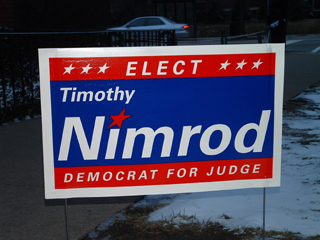
You see, there’s a Nimrod running for office. “Aren’t they all?” you rightly ask.

Yes, they are, but this time there’s an actual Nimrod running for office: Timothy D. Nimrod is running for a judgeship in the Cook County Circuit Court’s 9th Judicial Subcircuit Court.

Vote Nimrod, nimrod

Here’s a guy whose rulings will get overturned a lot. What appellate court’s going to be skittish about overturning a Judge Nimrod decision? But hey, Lodge #7 of the Chicago Fraternal Order of Police endorsed him! So he must be all right.

Should I walk the 20 feet to my polling place to register my ironic support for Candidate Nimrod? I think I’d be a nimrod not to.

Don’t these spics know how to fix an election?

Judging by some of the comments from the hawk crowd, the victory in Spain of the anti-Iraq war party is ipso facto a victory for Al Qaeda.

The hawks continue to conflate Iraq and Al Qaeda, mistaking Spaniards’ reasonable desire to do what little they can to remove themselves from the line of fire with weakness in the face of terrorism.

It may be true that there can be no appeasing Al Qaeda — if that’s who in fact was behind the March 11 attacks in Madrid — but the Spaniards seem to have made the eminently sensible decision that there was no point in continuing to participate in a war that brought no tangible benefits in the war on terror — since, you know, it was a diversion from it! — but may have exacted a terrible, terrible price.

But you know what? Screw those Spics. Now the Russkies know how to run things. Their guy, another Friend of Dubya, got re-elected with no trouble at all. Why can’t they all be like Putin? Or better yet, like Bush Buddy Pervez Musharraf, the wonderful Pakistani dictator friendly with Islamic extremists whose top nuclear scientist sold secrets to half the globe.

Anyway, Putin came into office on the strength of his tough-on-terror reputation. And, naturally, he was re-elected by a suspiciously overwhelming margin because the Chechen terror threat has been completely vanquished.

Right?

What’s worse? Re-electing someone in spite of the fact that their policies have not done one damn bit of good in actually stopping terrorist attacks, or deciding instead to choose an alternate route?

I’ll take the Spics’ so-called appeasement anyday.

UPDATE: The first and last word on this should really be Julian Sanchez’s fine essay at Reason Online.

If you’re for big gummint, at least advertise it!

Democratic “message adviser” Mark Penn makes a good point in this New Republic piece about Dubya’s first series of campaign ads:

The point of early advertising is not to reinforce your positives; it’s to plug holes in your negatives. … The issues that Americans care most about today are the ones where the president is weakest — the economy and health care. But rather than try to address this weakness, Bush seems content to avoid it.

Dubya, to the chagrin of advocates of limited government, has pushed or at least signed into law a series of big-government measures (as Tim Lee, to pick one of many, has pointed out), and yet he’s already falling back on tax cuts and strong defense as his core issues.

Subsidizing agribusiness, enacting protective tarriffs on behalf of steel companies, limiting political speech, federalizing education policy, pork-barrelling the transportation budget and vastly expanding Medicare may not be my cup of tea, but it’s the kind of crap Dubya’s signed off on for political purposes, presumably.

And now the political season has rolled around, and these “accomplishments” are nowhere to be seen in the Bush ads. Penn points out how adeptly Clinton used his administration’s support for additional federal death penalties and handing out dough to local police departments to cultivate a strong-on-crime image.

It’s well known that politicians often pass laws not in the public’s long-term interest but in their own short-term political interest. That’s about the only explanation for much of Dubya’s terrible domestic “agenda” — if such a word can be used for a policy of signing every piece of crap that comes across your desk.

And yet Rove & Co. don’t appear to be using this stuff to gain any kind of political advantage. So Dubya & Co. appear to not only be willing to depart from smaller government whenever it appears to suit their political purposes, but they are too incompetent to even follow up politically on those departures.

Once again this question occurs to any reasonable observer: Are these folks evil, or are they just stupid?

I ponder with dread the answer.

IJ, you J, we all J for IJ

In case you were curious, yes, Insurance Journal is still publishing. IJ Midwest has been going well so far, though it’s a lot more work than I was doing before. It’s been a challenge, definitely.

Here’s a link to the Feb. 23 issue of IJ Midwest online, and here’s one for the March 8 issue. I’ve been busy working on a couple of longer stories that will appear in upcoming issues, so there’s not much by me in either of these issues, aside from the little editor’s note.

I did write a couple of news stories, though. One about a group of state legislators specializing in insurance affairs that moved to password-protect its Web site, much to chagrin of the self-appointed consumer representatives. And a second story concerns a Missouri insurance department study that claims to show that the practice of using credit scores in rating and underwriting discriminates against minorities and the poor.

Enjoy!

They never thought it would happen in their little town

You may have heard that veteran actor Paul Winfield died last Sunday of a heart attack. He was 62, and was best known for a number of outsanding TV roles. But in the various obits I’ve seen, there’s nary a mention of his greatest accomplishment.

Winfield was the voice of A&E’s “City Confidential.” If you’ve ever watched an episode of the show, you know that it’s his voice that makes the otherwise humdrum “big murder in a small town” show so addictive, not to mention soporific.

A&E knows the score:

All of us at A&E Network were saddened to learn of the death of Paul Winfield. Paul was an extraordinary performer and a consummate professional. His distinct voice and sense of humor contributed so much to our critically acclaimed series “City Confidential.” We express our deepest sympathy to his family. Paul will be missed.

Posters to the show’s discussion board are devastated, and calling for A&E to honor the actor with a “Biography” special. On an old interview with “Fresh Air” that was replayed today, the first question Terry Gross asked was about Winfield’s voice.

Amazingly, he said he wasn’t very pleased with it. “I wish I had a deeper voice like James Earl Jones,” he said. On that basis, it seems to me that Jones is the only suitable replacement for Winfield as narrator of the show, though perhaps the “Autopsy” lady — Marlene Sanders — might be an interesting choice.

Read his lips: some new taxes, if …

Julian Sanchez, an often brilliant but occasionally misguided soul, argues in a recent piece for Reason Online that libertarians — er, fiscal conservatives — ought to jump on the repeal-the-puny-Bush-tax-cuts bandwagon.

If fiscal conservatives want to have any “credibility with liberals and moderates,” Sanchez writes, they ought to strike a Faustian tax-increase-for-budget-cuts deal with “the other side.” Another libertarian, Gene Healy, even dares to contemplate relations with that revenue-enhancement measure.

What Sanchez — who was last seen espousing government-run racial preferences programs — misses is that there is no “other side” that’s serious about reining in spending, not to mention the widespread and far-reaching limits on the scope of federal spending and activity that libertarians have in mind.

As Jim Henley writes, “If we’re going to agree to a distinction between tax cuts and smaller government, and give up the former, we need to make damn sure we get the latter.”

Where’s the Paul Tsongas in the Democratic race for president? Where’s the Paul Simon in the Senate? Heck, even Hillary doesn’t possess Clintonesque rectitude when it comes to deficit reduction.

What’s the Democrats’ major complaint about the hugely irresponsible Medicare prescription-drug entitlement? That it’s not generous enough! What’s the Democrats’ complaint about the No Child Left Behind Act? It’s underfunded! What’s their complaint about the Homeland Security Department? Its employees don’t get inflated labor-union wages and not enough is being spent on security risks such as … sewage plants in North Dakota.

On what planet are these people somehow moderates whom fiscal conservatives ought to be courting with promises of more tax revenues? Radley Balko provides more evidence of liberals’ inherent resistance to spending cuts — of nearly any kind. Maybe there are some more reasonable folks at the Urban Institute, but they’re not the ones currently making policy.

Julian’s essential point that the tax cuts are a short-term illusion that belie the long-term negative economic effects of gigantic budget deficits (as well as the national debt) is of course correct. Balanced budgets are important both for economic reasons and for advocacy reasons, as Julian again correctly points out (“In a world where legislators felt obligated to keep outlays connected by some tenuous thread to revenues, tax cuts would entail smaller government.”)

In the end, like Tyler Cowen, I’d take the deal, but that doesn’t mean we should be pushing for it.

The prescription Julian seems to provide is the path followed by H-Dubya when he was bamboozled by Congress into raising taxes. I can hear the refashioned rallying cry to smaller government now, echoes of Walter Mondale’s 1984 Democratic convention speech.

One of the advantages of being out of power is that libertarians don’t need to make the “sensible compromise.” They can and should, as far as its effective, agitate ceaselessly for smaller government across the board. There’s no need to give any quarter. There are plenty of others actually in power who will do that.

Tim Lee’s suggestion that we try to revive the Balanced Budget Amendment is an excellent one. John Kerry should take his advice, though I suspect that if such an amendment passed, the liberal fetish a la mode for balanced budgets would disappear instantly. But at least then the old debates about the size and scope of government could be argued on a more honest level than now, when both sides pretend we can have our enormous cake and eat it too.

In the meantime, the common perception is still that taxation alone is the cost of government. The dissonance between claiming to advocate smaller government while simultaneously pushing for — or even accepting as a compromise — higher taxes would be jarring to the general public. This proposed grand bargain, if pursued, would not only be a fool’s errand but would seriously undermine the libertarian’s case for smaller government across the board.

Lost time is not found again

A few odds and ends:

  • Pedro Gomez writes for ESPN.com that a Latin American city (my favorite is Monterrey, Mexico) deserves the Expos. Certainly, just about any place deserves the Expos more than Washington, D.C., does — though I’m generally in favor of providing politicians with as many diversions from lawmaking as possible.
  • Out late on the town and looking for some grub? Lunarama has a growing directory of 24-hour restaurants. (Link courtesy of El Papote.)
  • Radley Balko gives it up for a guy with guts, retiring Sen. Peter Fitzgerald. Among other things, Fitzgerald opposed Congressional attempts to federally preempt the Illinois legislature on an issue of local concern, whether O’Hare International Airport ought to be expanded. Ultimately, the pro-expansion Democrats retook the governor’s mansion making the issue moot. They pushed expansion, which by eminent domain will result in the displacement of hundreds of residents and two cemeteries in the surrounding area. It will also result in years of public contracts to be controlled by — guess who? — Da Mare. Surprise, now the city’s original cost estimate has doubled. And that’s even before the costs of good ol’ Chicago corruption are even taken into account.
  • The Feb. 9 issue of Insurance Journal Midwest is now online.

Why Maddux won’t be wearing (Yankee) pinstripes

I think there’s strong reason to believe that the unconfirmed reports that the evil, evil Yankees are close to signing Greg Maddux won’t be confirmed anytime soon.

Not only has the Yankees General Manager Brian Cashman consistently denied that the Yankees are even negotiating with Boras, Maddux’s agent, but it’s clear the team has other priorities, including first base and second base.

Apparently, seven all-stars in the everyday lineup just isn’t enough. If anything, the Yankees would be interested in a left-handed starter, which Maddux of course is not. Even if the Yankees were pursuing him, it’s hard to take seriously the idea that Maddux, after insisting for the entire off-season that he wanted to be closer to his home in Las Vegas, would sign with a team 800 miles farther away than Chicago is.

Lastly, there’s no way that Red Sox and Cubs fans’ hearts could be crushed so dramatically within the space of a few days. That could never happen!