Depressing quote of the day

“They were good up to about 14,” said Mattie Ashford, 77, who helped raise them after their mother died when they were 3. “Then they started running with the wrong crowd, getting into trouble.”

So says the grandmother of twin 17-year-old men, now both in jail. One brother was charged Wednesday with murder in an iPhone robbery gone wrong on the el. The other acted as his lookout and accomplice in a series of robberies across the city.

Read the rest of Jeremy Gorner and Jason Meisner’s impressively sad Chicago Tribune story on the case.

Golden again

I’m pleased to report that the American Society of Healthcare Publication Editors recently honored two of my stories — “Katrina’s legacy: Moving beyond the storm” and “Katrina’s legacy: Rethinking disaster planning” — with the gold award in their best feature article series category.

I was afforded the opportunity to travel to New Orleans last year to do some first-hand reporting on how its recovery has progressed. I owe a debt to my editor, Damon Adams, for helping to make that happen. Click here for the slide show that ran online with the “Moving Beyond the Storm” story. And here’s a little music:

Ballooning over Sedona, Ariz.

The sun rises over the red rocks of Sedona, Ariz.

The sun rises over the red rocks of Sedona, Ariz.

Earlier this month, Elizabeth and I traveled to Sedona, Ariz. — and then floated above it, courtesy of Red Rock Balloon Adventures. The shot above is one of my favorite pictures from our journey into the skies over one of the loveliest spots on Earth. Here are the rest of my photos from the trip.

Click here to see the rest of my pictures from the trip. Here are some photos from an earlier trip to Sedona.

The serf of some media

Well, after my recent TV appearance, it is only natural to follow up by broadening my media reach to include the world of books.

A January 2009 feature article I wrote for American Medical News, “Redefining death: A new ethical dilemma,” is included in a new textbook issued by Greenhaven Press. The book, “Bioethics in Mary Shelley’s Frankenstein,” is part of the publisher’s “Social Issues in Literature” series aimed at high-school students and is meant to be a companion for when they read the novel.

The book is broken into three sections — one with background about Shelley, the second featuring commentaries on bioethical issues in the novel, and the third highlighting “contemporary perspectives on bioethics.” That third section is where my story on transplant physicians pushing the boundaries of what constitutes death comes in. Greenhaven sent me a complimentary copy of the book, and perhaps this will push me to actually read the Shelley classic.

The important thing to note is that my prose may now potentially help educate America’s youth — a frightening prospect, indeed. This is almost as scary as when one of my articles — about a poll on physicians’ views of doctor-assisted suicide — was cited by a Montana judge in her opinion (page 22) granting terminally ill patients in that state the constitutional right to physician-aided death. Alarmingly, my sphere of influence is growing ever wider.

TV talkin’ post

Yours truly on ESPN. Photo by Pam Dolan.

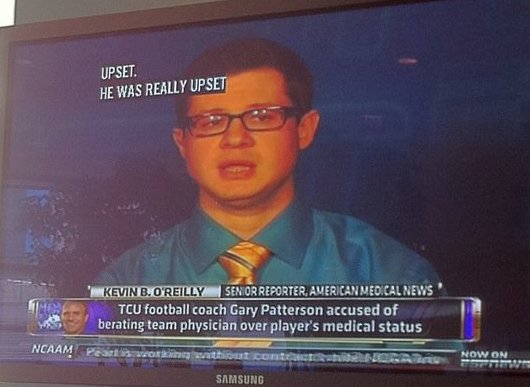
So, my “Put me in, Doc” story blew up last week and by Friday, landed me on ESPN for a brief, live on-camera segment with Bob Ley on “Outside the Lines.”

When Dr. Haraldson told me the story that I used as the lede in my article, I knew it would make a splendid anecdote to illustrate the team physician’s ethical dilemma.

I did not predict, however,  that it would create such a splash in Dallas, Fort Worth and across the college football and sports world. That just shows that my news judgment still has a ways to go.

Here is a rough transcript of my ESPN appearance (scroll down, no video found yet UPDATE: here’s the video), which includes a few of the sweetest words I’ve ever heard uttered: “Now we say hello to Kevin O’Reilly, who reports for American Medical News and first broke this story.”

My TV caught fire

Here’s something I wrote about a month after the 9/11 attacks.


The Page

A month ago, my TV caught fire
With the explosion of a new age
The smoke and ash of dying dreams
Buried the remains of a scattered page

On that page was written the record
Of a trial, a trade, a law, a life
A deal gone sour over mislaid details
A string of betrayals by a faithless wife

On that page was written a telephone bill
For the last desperate call that was made
To her husband’s answering machine
Before she fell victim to a box-cutter blade

That page laid out the measurements
For an insured engagement ring
Thousands died for a political world
But they never did a goddamn thing

On that page was printed a forgotten e-mail
“I’m sorry, honey, for the things that I said
In the heat of the moment, I let my tongue slip
I’ll do better, I promise,” was the way that it read

That page was trimmed with the threadbare
Lives of men and women I never knew
It was soaked in the searching tears
That I spat out so hard for you

A month ago, and that page has been printed
A trillion times over with words bitter and rank
To describe the evil that brought down the ash
A month has gone by — and the page is still blank

– 30 –

City of Chicago, Richard M. Daley, Mayor

Here is a little something I wrote a few years back, but given the news it seems appropriate to publish it now.


Come from the East
Come from the West
Back to the town
We love the best
By boat, by plane
By land, by air
We find this tidbit
Everywhere
To remind us of our master
As if we hadn’t been aware
It says, “City of Chicago
Richard M. Daley, Mayor”

It seems no inch of property
Escapes Hizzoner’s glare
Without his leaden stamp
Is it really even there?
Why, even babies’ heads
Are marked before they grow their hair
Welcome to the world, my boy
But you had better beware
You’re in the City of Chicago
Richard M. Daley, Mayor

Bundled up in business cazh
Or attached to fanny packs
On a muggy Mag Mile morning
The throng is making tracks
Past dem purty flower boxes
Past a prophet’s jumbled prayer
Much to do, much to see
Can’t stop, can’t spare
In the City of Chicago
Richard M. Daley, Mayor

He arrived as “Rich”
But today he’s Da Mare
In daddy’s footsteps
City Hall’s rightful heir
Cronies and crooks
Creep up on the screen
We’re so damn amazed
By a magical Bean
Behind every denial
Just a hint of despair
In the City of Chicago
Richard M. Daley, Mayor

– 30 –

Away we go

Kevin & Elizabeth

Hours after the engagement

As some of you may already know, I got engaged last week. I proposed to the smart, funny, gorgeous Elizabeth Harding last Saturday morning after a walk along the lake. I was delighted when she responded: “Yes, I will marry you.”

There is no date yet for the wedding, and we are not in any particular rush to set one.

Elizabeth is a Unitarian Universalist minister. Right now, she is consulting minister at Prairie Circle Unitarian Universalist Congregation in Grayslake, Ill. You can read some of her sermons here.

Interestingly, Elizabeth and I have known each other — after a fashion — since we were 4 years old. We attended the Inter-American Magnet School from preschool through the eighth grade. I can safely say that we were not close back then. If we ever exchanged more than a few sentences of conversation during those 10 years, I’ve entirely forgotten them.

But you seemingly cannot maintain any presence on Facebook for long without your past creeping up on you. In this case, it was a benevolent creeping. Once the number of Inter-American grads who had connected on Facebook reached a tipping point, it was clearly time to reunite, albeit unofficially. Elizabeth did not attend the first get-together, but she did make it out for a second reunion last June. Lucky me!

As we milled around Navy Pier before heading to the Reagle Beagle (which I recommend for kitsch value alone), I explained to Elizabeth that I had taken to using Twitter to explore important topics such as my need for a system to tell apart my black dress socks from my navy blue ones. She laughed.

You know, when a pretty girl laughs at your jokes, she has a way of getting your hopes up. I am constantly on my guard against false hope. As a Cubs fan, I’ve developed a kind of self-protective hope allergy, especially after 1984 and 2003. But in this case, I let my hopes get the better of me. I let myself get carried away. I chose wisely.

So now are we engaged. We are, most assuredly, carried away. Where shall we go? I look forward to the adventure of finding out.

I am a golden god

I mean, I always thought so, but now it’s been confirmed by an outside source.

The American Society of Business Publication Editors‘ Midwest-South Region handed out its annual “Azbee” awards last night and I was a winner. One of my articles from last year — “Oregon still stands alone: Ten years of physician-assisted suicide” — won the gold award in the feature article category.

Here are the first few grafs of the story, which ran months before Washington became the second state to legalize doctor-aided dying:

It was 10 springs ago that a Portland woman in her mid-80s sat to talk about her impending death. Doctors guessed the metastatic breast cancer wracking her body would kill her within two months. As the city shook off its winter slumber, the woman — whose identity is still a secret — anticipated her eternal rest.

“I’m looking forward to it,” she said in a recording later made available to reporters. “I can’t see myself living a few more months like this.”

Disease set her on the path toward death, but the woman was determined to choose when and how to take her final steps. For that, she needed a doctor’s help.

On a Tuesday in 1998, in the presence of her family, she became the first patient to commit suicide with a physician’s aid under Oregon’s Death With Dignity Act.

A physician prescribed a lethal dose of barbiturates. The woman washed down a mixture of the medication and syrup with a glass of brandy and died shortly thereafter.

Whether the path chosen was a victory for patient autonomy or an ethical tragedy depends upon one’s view of this wrenching issue. But what is clear — and what comes as a surprise given the predictions of supporters and opponents of physician-assisted suicide — is that it is a path still lightly traveled.

Through the end of last year, only 340 more Oregonians had chosen physician-assisted suicide. And after a decade, Oregon still stands as the lone state to legalize the practice.

There is no tidal wave of patients moving to Oregon to die, and there is no evidence of a slippery slope toward involuntary euthanasia there, as opponents once feared. At the same time, there is no sign that many states will rush to follow Oregon’s lead on physician-assisted suicide, as supporters still hope.

Though Oregon’s law remains seldom used and unduplicated, its impact on physicians, patients and the movement to improve end-of-life care cannot be overstated.

The whole shebang.

Ethics block

In Slate magazine, Farhad Manjoo writes that “it’s hard to make an honest claim that [Web ad-blocking] programs are ethical,” though he doesn’t bother to rebut head-on the perfectly valid arguments he mentions (“it’s my browser and my computer, so I can choose what I want to download”).

Steven D. Schroeder at Sturgeon’s Law does an excellent job of taking apart Manjoo’s claim. I also tackled the argument back in 2005, here. By the way, if Manjoo thinks ad-blocking plug-ins are problematic, he’ll probably compare the folks behind Readability to Charles Manson.