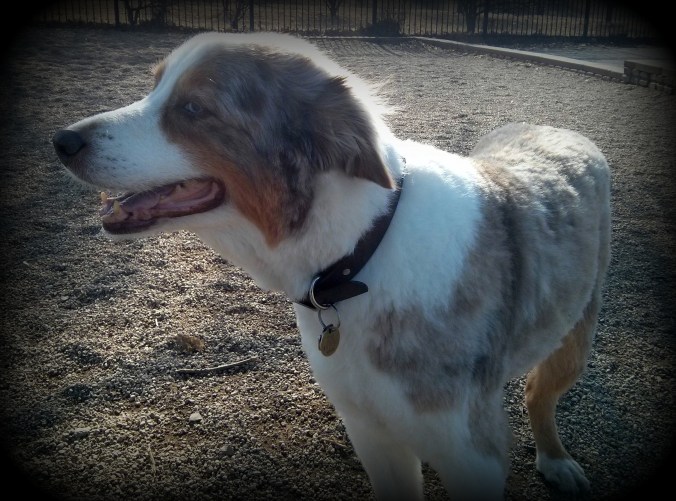
OK. Go.

Bob O'Reilly, 2004-2015

Bob O’Reilly, 2004-2015

It was nearly a decade ago that my ex-wife and I adopted Bob, and it has been one hell of a ride. He was a lover, a fighter, a tubthumper, the bearer of many names, a movie star and the star of a sermon (which, sadly, is not available online). He was, above all, so very present, typical of the Australian Shepherd‘s “velcro dog” tendencies.

Which has made it all the more difficult to bear his absence in the week since we put Bob to sleep, following his long struggle with canine renal failure. When doing training with Bob, among the commands I learned was one to release him from his sit, stay or down. “OK. Go,” I was taught to say in a nonchalant manner. The idea was — hey, you listened, you obeyed. Swell. Now you’re free. No big deal. Go ahead, run around.

OK, Bob. Go.

Update: I forgot I had taken this brief video of Bob cavorting at the beach. What a find!

Traveling with Lee Sandlin

Lee Sandlin died earlier this month. What a tremendous loss. He was a fantastic writer, and I was lucky to make his acquaintance. Here’s an obit by Michael Miner in the Chicago Reader, the longtime home for his singular brand of narrative nonfiction.

A celebration of his life and work was held recently at Chicago’s Sulzer Library and his wife, Nina (@nsandlin) — a good friend of mine from our days together at the late, great American Medical News —  asked me to contribute some thoughts. Here they are below. I post them here principally for the opportunity to share a bit of Lee’s writerly genius, and to encourage you all to read as much of his work as you can, as soon as possible.


To read is to place your trust in the hands of another, typically a stranger. When you read, the general rule is that most of what you know, what you believe about a subject, what you feel and hear and see in the mind’s eye, is shaped by your guide, the author. There was no better guide than Lee Sandlin.

The road he led you down may have been full of pit stops and detours, but every one was worth all the while. In a world where the written word is defiled by inattentiveness and, worse yet, artlessness, he kept a great faith with himself and with his readers. And, boy, did his prose show you how to go. In “Wicked River,” he wrote:

There were no beacons or lighthouses or channel buoys on the river then; there were no official markers of any kind. Here and there someone would occasionally paint a warning or an arrow on a prominent rock to alert voyageurs to danger — but these were often the work of pirates, to trick boats into going aground. Nor were there any reliable maps. In that era, mapmaking, even at its best, was a mixture of supposition, obsolete or garbled information, and pure fantasy; the first rule of travel in the American interior was that only a fool trusted a commercial map.

But the voyageurs didn’t care. What did they need a map for? The land was so wild it was essentially impassable; anyone who didn’t go by the river didn’t go at all. In effect, the river served as its own map. A voyageur who needed to consult it had only to climb the nearest hill. There the route was unfolded, in all its blue-misted splendor: the great dragon tail of the river uncoiling through forested valleys and across the tallgrass prairies and into the vast shrouded swamps, glittering with ten thousand sunflecks, blurred by drifts of drizzle, blazing with reflected herds of brilliant cumulus, on and on toward the horizon. As far as the eye could see, the river was the only road.

I would give a pinky finger to write sentences so pure, so authoritative, so precise, so true. I feel lucky to have read them, and doubly fortunate to have had the opportunity to share with Lee how much they meant to me, thanks to my friendship with his lovely wife, Nina.

One could call writing like Lee’s majestic, or lyrical, those book-review workhorse words. Posh! I say. When we see nonfiction writing like this again (as will surely be rare), I suggest we call it Sandlinesque. That will be a true compliment. Thank you, Lee, for letting us travel with you. On and on, toward the horizon!

Health care industry reacting to overtesting, overtreatment

Carla Johnson’s lede:

The American health care system wastes an estimated $750 billion a year, according to the Institute of Medicine. At a recent AHCJ chapter event in Chicago, four panelists discussed one source of that waste: unnecessary tests and procedures.

Moderated and organized by AHCJ member Kevin B. O’Reilly, senior editor of CAP Today, the panel looked at the issue through the lenses of doctors, journalists, health system executives and academics.

Read the whole shebang at the Association of Health Care Journalists’ Covering Health blog.

Here is Lucas

Today marks the one-month birthday of our son, Lucas. Elizabeth is doing a marvelous job ensuring that he is properly nourished, and he is growing quite beautifully. Lucas has so many looks. Here he is being pensive.

Lucas-Baby Bella-05

You can stay updated on Luke’s evolving appearance at his (password-protected) website. For access, please send your request to the address below. Thanks.

emailimage

Here is my new cubicle …

2013-11-04 10.00.29 … at the College of American Pathologists, where I started a position Monday as senior editor for a monthly magazine the college publishes, CAP TODAY. The publication focuses principally on clinical issues in pathology, laboratory medicine and laboratory management. So, I have a lot to learn. The job is out in the suburb of Northfield, so I had to buy a car to make the daily commute. It’s interesting work so far and, hey, free coffee! I will, as I’ve done with all my previous jobs, post links to my articles. Given the audience at which the publication is aimed, however, these stories may be less accessible to the general reader than most of my previous work.

Health care reads for Sept. 16, 2013

In Sunday’s Chicago Tribune, Peter Frost reports that Illinois is way behind other states in getting the word out about buying insurance under the Affordable Care Act:

At the Minnesota State Fair last month, state employees handed out thousands of paperboard fans bearing pictures of Paul Bunyan and Babe the Blue Ox to promote Minnesota’s health insurance marketplace.

Over Connecticut beaches this summer, airplanes flew banners emblazoned with “Get Covered!” as teams below distributed free sunscreen packets as part of the state’s campaign to get more of its residents insured under the Affordable Care Act.

In Colorado, Oregon and a handful of other states, radio and TV spots have been running for weeks encouraging the uninsured to seek health coverage starting Oct. 1.

In Illinois so far? Mostly silence.

The whole shebang.

And in New York magazine, Jonathan Chait attempts to explain — at length — why Obamacare “continues to drive many Republicans to madness.” He begins:

The Republican party has voted unanimously against establishing the Affordable Care Act in the Senate and then in the House of Representatives, then voted some 40 times to repeal or cripple it; it has mounted a nearly successful campaign to nullify it through the courts and a failed presidential campaign that promised to repeal it; and it has used its control of state governments to block the law’s implementation across vast swaths of the country, at enormous economic cost to those states. Yet somehow, in the wake of all this, the party is consumed with the question Have we done enough to stop Obamacare?

The whole shebang.

Shut down

Yesterday, the American Medical Association announced that it will shut down American Medical News — where I’ve worked as a reporter since 2005 — effective Sept. 9. Our last day in the office will be Aug. 28. Here’s a largely accurate Chicago Tribune report.

Which means that as of the end of the month, I’ll be free to bring my talents to your fine organization. If you (or someone you know) are in need of temporary or ongoing assistance from a top-notch writer, editor and communicator with deep experience reporting for sophisticated audiences, please get in touch:

emailimage

Here is my LinkedIn profile.

The fire across the street

On Saturday afternoon, I was absorbed in a big reorganization project on my computer so I didn’t pay much mind when sirens started to sound. Epworth United Methodist Church across the street runs a shelter and there have been a handful of times when ambulances have been called out to cart folks away for treatment.

But the sirens got louder and I heard yells through my closed windows. I looked up from my desk and saw this:

The roof was on fire

You can see that the fire truck has recently arrived and a firefighter is lugging the fire hose up the steps of the parsonage. It was fascinating to watch from my window as the men  fearlessly fought the fire, extending the ladder across the street to hack their way through the roof to go at it from above. A crowd of dozens gathered to watch. Within minutes, the fire was safely under control and it was out completely within the hour. No one was hurt, I learned later.

Later that evening, the board-up company was there doing its job, hammering away through the night. I awoke to this sight:

I'm so board with the U.S.A.

It felt scary enough to me — I could feel the heat and smell the smoke from across the street — but the firefighters apparently did their job well. It didn’t even make the news, so far as I can tell.

Update: While no one was hurt, the pastor and his family are living in a Super 8 for the time being. All of their clothes and most of their belongings were destroyed by smoke and fire-hose water.

When the Dawn

I initially wrote this soon after Elizabeth and I began dating. I revised it recently and it seems appropriate, given our recent wedding celebration, to share it here.


When the day is a dunce, dropping itself unceremoniously upon
Its helpless victims, those fools who awoke expecting
Or hoping, against hope, for brilliantine benevolence

When the night is a nincompoop, crawling clumsily upon
Its cooperating witnesses, those ne’er-do-wells who lie awake pondering
What they maybe, might have, could have done, or been

When the morning is a malcontent, thrusting itself unremorsefully upon
Its undercover agents, those daydreamers busy dredging
Inconceivable-seeming days against the crooked currents

When the night has come again
And the land is dark
Well, then, what wonder have we here?

Sweetness and light!
Twinkling with a casual brilliance
Enfolding with the night
Standing at the crossroads
Walking amid the bogs and marshes
Past little boxes made of ticky-tacky
Accompanying what is present
And supplying what is lacking
Bedecked by boisterous eyes
And limned by lavishing lips
Brightening the sanctuaries
Drawing dignity within reach
Darkening the door
And daring to eat a peach

When the dawn is irradiated, shining unapologetically upon
Its reliable sources, those cloying crooners who rise singing
Unabashedly trumpeting their sweetness and light

When they march gaily across the glen
And the sun is high
Well, then, what wonder have we here?

– 30 –

Why so unserious?

In Red Eye, Melanie Zanona writes about a recent series of street attacks in Chicago:

While none of the victims were seriously injured — the Michigan man suffered a broken jaw and the Gold Coast man suffered lacerations and bruises to his head and body — the attacks have once again raised concerns among Chicagoans and tourists on how to protect themselves.

Hmm. If my jaw were broken, I’m pretty sure I’d consider it a serious injury.