… spotted in the June 2004 edition of Liberty magazine, penned by Eric Kenning:
English grammar and syntax are out of the range of George W. Bush, who starts sentences the way he starts wars, without any idea of how they will end.
Beautiful!
… spotted in the June 2004 edition of Liberty magazine, penned by Eric Kenning:
English grammar and syntax are out of the range of George W. Bush, who starts sentences the way he starts wars, without any idea of how they will end.
Beautiful!
If you haven’t seen them yet, here are some censored versions of the photos of abuse of Iraqi prisoners by U.S. soldiers. Unfortunately, these abuses cannot be discounted as the actions of a few idiots. Rather, the problem was systemic, as discovered by an internal Army report leaked to New Yorker reporter Seymour Hersh (who else?).
The report, by Major Gen. Antonio Taguba, listed some of the wrongdoing:
Breaking chemical lights and pouring the phosphoric liquid on detainees; pouring cold water on naked detainees; beating detainees with a broom handle and a chair; threatening male detainees with rape; allowing a military police guard to stitch the wound of a detainee who was injured after being slammed against the wall in his cell; sodomizing a detainee with a chemical light and perhaps a broom stick, and using military working dogs to frighten and intimidate detainees with threats of attack, and in one instance actually biting a detainee.
This pervasive torture at Abu Ghraib — the infamous chamber of horrors during the Hussein regime — was ordered by the military-intelligence forces in an attempt to extract better information about the anti-U.S. insurgency.
Until now, I thought that this war and this occupation, while well-intentioned was severely misguided. It was a noble but stupid attempt to make America more secure by attempting to socially re-engineer the Middle East. But now, now I am truly ashamed of what the U.S. government is doing in my name. It’s unclear how the practice of occupation — of, at this point let’s face it, oppression — can be separated from its intentions.
What else can I say? Damnit, damnit, damnit.
I love this bit from one of the excerpts from Bob Woodward’s new book, “Plan of Attack”:
The Joint Chiefs’ staff had placed a peppermint at each place. Bush unwrapped his and popped it into his mouth. Later he eyed Cohen’s mint and flashed a pantomime query, Do you want that? Cohen signaled no, so Bush reached over and took it. Near the end of the hour-and-a-quarter briefing, the chairman of the Joint Chiefs, Army Gen. Henry H. Shelton, noticed Bush eyeing his mint, so he passed it over.
To paraphrase Nelson Muntz: By the end, his breath was so fresh, he wasn’t really the president anymore.
George Dubya, that is.
At least, I think that’s the lesson we are supposed to draw from Dubya’s “Compassion Action” photo gallery at his campaign Web site.
As Amy Phillips points out, of the 23 photos in the gallery, all but one picture Dubya interacting with nonwhite people. Perhaps the folks behind the hilarious Black People Love Us! site were hired on to head up the GeorgeWBush.com design team.
Apparently not. While 4,156 brave souls voted for Timmy Nimrod yesterday, his 13.1 percent of the vote was only good enough for fourth place in the race for the Cook County 9th Judicial Subcircuit vacancy.
I guess it’s true what they say: Irony really is dead.
Blair Hull, the Illinois Democratic senatorial candidate cokehead wifebeater with no qualifications for the job and a pocketful of cash, spent $29 million of his own money and wound up netting just under 11 percent of the vote.
The raw number is actually 133,274 votes. Hull spent $217.59 per vote! Talk about a poor return on your investment.
In a larger sense, though, I wonder what kind of ego a person must possess to believe that — knowing he has a shady past, no experience and no ideas — he could or should win his party’s nomination for U.S. Senate. What a disgusting waste of money. The principal issue Hull demagogued emphasized was the cost of prescription drugs. Many of his inescapable TV ads showed him taking a bus full of seniors into Canada to buy price-controlled medicine there.
Instead of wasting his money on an ego-trip — not to suggest that Illinoisans won’t cherish his campaign’s numerous flyers for years to come — Hull could have used that $30 million to seed a charitable foundation to help needy seniors to buy life-saving prescription drugs. Instead he wasted it trying to win power and glory for himself, so he could agitate to force everyone else to pay for seniors’ drugs whether they need the help or not.
I’m a little more sympathetic to career politicians with bad ideas. Most politicians’ ideas are bad but hey — gotta talk about somethin’, right? It’s not like they have the talent or inclination to do anything productive with their lives. It’s kind of a self-selecting process. We segregate the useless into the political class. What’s even more alarming is when people who’ve actually had successful careers in the private sector consciously decide to enter politics, especially if they’re looking to grow government power rather than shrink it.
Most politicians have some kind of congenital defect that forces them into the field. In that respect, they’re relatively blameless. We don’t blame jockeys for being short. But the mid-career political novices like Hull are more analogous to somebody who chops his legs in half to become a jockey — obviously deranged.
I am getting so fed up with the hawks’ tireless insistence that Dubya & Co. never claimed that Iraq presented an “imminent threat.”
Let’s assume for a moment that it’s true that they didn’t in so many words — or so many others — use that line of argument. To me the natural follow-up question is this: Should U.S. foreign policy post-9/11 be putting the overwhelming majority of its intellectual, human, physical and financial resources into fighting a threat that is not imminent?
You can say a lot of things about 9/11, but it sure as hell showed that Al Qaeda was not just an imminent threat, but a proven threat. Why was it wise to drain resources from that effort?
Might the folks who died in the Bali, Istanbul, Riyadh and Madrid attacks be alive today if Dubya & Co. just stuck to the game plan? It’s impossible to know. But if they’re to get credit for Iraq, they should get some portion of the blame for those tragic events.

The above image is from the Chicago Tribune’s home page today and unintentionally says a great deal about what’s wrong with politics in America today … but that’s not what this post is about.
As usual, Illinois will play the crucial presidential primary role of being completely irrelevant, so even if I were a Democrat I’d have little reason to vote today, except to choose between a bunch of subpar U.S. senatorial candidates.
And yet, a glimmer of hope pierces the darkness of this election day — I have the opportunity use my vote as an ironic gesture.
You see, there’s a Nimrod running for office. “Aren’t they all?” you rightly ask.
Yes, they are, but this time there’s an actual Nimrod running for office: Timothy D. Nimrod is running for a judgeship in the Cook County Circuit Court’s 9th Judicial Subcircuit Court.
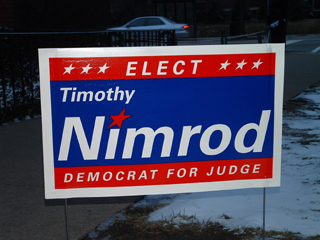
Here’s a guy whose rulings will get overturned a lot. What appellate court’s going to be skittish about overturning a Judge Nimrod decision? But hey, Lodge #7 of the Chicago Fraternal Order of Police endorsed him! So he must be all right.
Should I walk the 20 feet to my polling place to register my ironic support for Candidate Nimrod? I think I’d be a nimrod not to.
Judging by some of the comments from the hawk crowd, the victory in Spain of the anti-Iraq war party is ipso facto a victory for Al Qaeda.
The hawks continue to conflate Iraq and Al Qaeda, mistaking Spaniards’ reasonable desire to do what little they can to remove themselves from the line of fire with weakness in the face of terrorism.
It may be true that there can be no appeasing Al Qaeda — if that’s who in fact was behind the March 11 attacks in Madrid — but the Spaniards seem to have made the eminently sensible decision that there was no point in continuing to participate in a war that brought no tangible benefits in the war on terror — since, you know, it was a diversion from it! — but may have exacted a terrible, terrible price.
But you know what? Screw those Spics. Now the Russkies know how to run things. Their guy, another Friend of Dubya, got re-elected with no trouble at all. Why can’t they all be like Putin? Or better yet, like Bush Buddy Pervez Musharraf, the wonderful Pakistani dictator friendly with Islamic extremists whose top nuclear scientist sold secrets to half the globe.
Anyway, Putin came into office on the strength of his tough-on-terror reputation. And, naturally, he was re-elected by a suspiciously overwhelming margin because the Chechen terror threat has been completely vanquished.
Right?
What’s worse? Re-electing someone in spite of the fact that their policies have not done one damn bit of good in actually stopping terrorist attacks, or deciding instead to choose an alternate route?
I’ll take the Spics’ so-called appeasement anyday.
UPDATE: The first and last word on this should really be Julian Sanchez’s fine essay at Reason Online.
Democratic “message adviser” Mark Penn makes a good point in this New Republic piece about Dubya’s first series of campaign ads:
The point of early advertising is not to reinforce your positives; it’s to plug holes in your negatives. … The issues that Americans care most about today are the ones where the president is weakest — the economy and health care. But rather than try to address this weakness, Bush seems content to avoid it.
Dubya, to the chagrin of advocates of limited government, has pushed or at least signed into law a series of big-government measures (as Tim Lee, to pick one of many, has pointed out), and yet he’s already falling back on tax cuts and strong defense as his core issues.
Subsidizing agribusiness, enacting protective tarriffs on behalf of steel companies, limiting political speech, federalizing education policy, pork-barrelling the transportation budget and vastly expanding Medicare may not be my cup of tea, but it’s the kind of crap Dubya’s signed off on for political purposes, presumably.
And now the political season has rolled around, and these “accomplishments” are nowhere to be seen in the Bush ads. Penn points out how adeptly Clinton used his administration’s support for additional federal death penalties and handing out dough to local police departments to cultivate a strong-on-crime image.
It’s well known that politicians often pass laws not in the public’s long-term interest but in their own short-term political interest. That’s about the only explanation for much of Dubya’s terrible domestic “agenda” — if such a word can be used for a policy of signing every piece of crap that comes across your desk.
And yet Rove & Co. don’t appear to be using this stuff to gain any kind of political advantage. So Dubya & Co. appear to not only be willing to depart from smaller government whenever it appears to suit their political purposes, but they are too incompetent to even follow up politically on those departures.
Once again this question occurs to any reasonable observer: Are these folks evil, or are they just stupid?
I ponder with dread the answer.
Julian Sanchez, an often brilliant but occasionally misguided soul, argues in a recent piece for Reason Online that libertarians — er, fiscal conservatives — ought to jump on the repeal-the-puny-Bush-tax-cuts bandwagon.
If fiscal conservatives want to have any “credibility with liberals and moderates,” Sanchez writes, they ought to strike a Faustian tax-increase-for-budget-cuts deal with “the other side.” Another libertarian, Gene Healy, even dares to contemplate relations with that revenue-enhancement measure.
What Sanchez — who was last seen espousing government-run racial preferences programs — misses is that there is no “other side” that’s serious about reining in spending, not to mention the widespread and far-reaching limits on the scope of federal spending and activity that libertarians have in mind.
As Jim Henley writes, “If we’re going to agree to a distinction between tax cuts and smaller government, and give up the former, we need to make damn sure we get the latter.”
Where’s the Paul Tsongas in the Democratic race for president? Where’s the Paul Simon in the Senate? Heck, even Hillary doesn’t possess Clintonesque rectitude when it comes to deficit reduction.
What’s the Democrats’ major complaint about the hugely irresponsible Medicare prescription-drug entitlement? That it’s not generous enough! What’s the Democrats’ complaint about the No Child Left Behind Act? It’s underfunded! What’s their complaint about the Homeland Security Department? Its employees don’t get inflated labor-union wages and not enough is being spent on security risks such as … sewage plants in North Dakota.
On what planet are these people somehow moderates whom fiscal conservatives ought to be courting with promises of more tax revenues? Radley Balko provides more evidence of liberals’ inherent resistance to spending cuts — of nearly any kind. Maybe there are some more reasonable folks at the Urban Institute, but they’re not the ones currently making policy.
Julian’s essential point that the tax cuts are a short-term illusion that belie the long-term negative economic effects of gigantic budget deficits (as well as the national debt) is of course correct. Balanced budgets are important both for economic reasons and for advocacy reasons, as Julian again correctly points out (“In a world where legislators felt obligated to keep outlays connected by some tenuous thread to revenues, tax cuts would entail smaller government.”)
In the end, like Tyler Cowen, I’d take the deal, but that doesn’t mean we should be pushing for it.
The prescription Julian seems to provide is the path followed by H-Dubya when he was bamboozled by Congress into raising taxes. I can hear the refashioned rallying cry to smaller government now, echoes of Walter Mondale’s 1984 Democratic convention speech.
One of the advantages of being out of power is that libertarians don’t need to make the “sensible compromise.” They can and should, as far as its effective, agitate ceaselessly for smaller government across the board. There’s no need to give any quarter. There are plenty of others actually in power who will do that.
Tim Lee’s suggestion that we try to revive the Balanced Budget Amendment is an excellent one. John Kerry should take his advice, though I suspect that if such an amendment passed, the liberal fetish a la mode for balanced budgets would disappear instantly. But at least then the old debates about the size and scope of government could be argued on a more honest level than now, when both sides pretend we can have our enormous cake and eat it too.
In the meantime, the common perception is still that taxation alone is the cost of government. The dissonance between claiming to advocate smaller government while simultaneously pushing for — or even accepting as a compromise — higher taxes would be jarring to the general public. This proposed grand bargain, if pursued, would not only be a fool’s errand but would seriously undermine the libertarian’s case for smaller government across the board.
A few odds and ends:
I now remember why I used to like Andrew Sullivan, before he went nuts post-9/11.
 kboreilly.com
You must be logged in to post a comment.