Major disruption ahead for labs, says industry analyst

A shrinking pool of cash to pay for medical care, the decline of private practice medicine, and recently enacted federal legislation will combine to put the squeeze on medical laboratories. That was the stark and sobering message delivered to the hundreds of administrators, pathologists, and other lab professionals who gathered in New Orleans in late April and early May for the Executive War College.

The bearer of the bad news was Robert L. Michel, editor-in-chief of The Dark Report, which hosts the annual meeting. Michel said the biggest threat facing labs is implementation of the Protecting Access to Medicare Act of 2014. The legislation, signed into law April 1, contains a one-year delay in big Medicare physician pay cuts due to the sustainable growth rate formula. But it also includes major changes to the Medicare clinical laboratory fee schedule that will pose a huge challenge to labs, Michel said.

My latest in CAP TODAY’s Put it On the Board section. Read the whole shebang.
Third cervical cancer screening paradigm may be on the way

Clinical trial data and a Food and Drug Administration panel’s full-throated endorsement stand to reshape cervical cancer screening practice recommendations in the U.S.

The FDA’s Microbiology Devices Advisory Committee in March voted 13-0 in favor of a new indication for Roche’s Cobas human papillomavirus test that would allow the assay to be used as a primary screen for cervical cancer in women 25 and older. At this article’s deadline, the FDA had not yet acted on the panel’s advice but the agency usually heeds its advisory committees’ recommendations.

My latest in CAP TODAY’s Put it on the Board section. Read the whole shebang.

Putting it on the board

A back-page section in CAP TODAY that I’ve been working to beef up is called “Put it On the Board.” I usually contribute a fairly well reported lead news item of a few hundred words.

Back in January, I examined the need for faster, simpler tests to diagnose infectious diseases. In February, the story looked at explosive growth in the field of genomics and how difficult it is to translate benchside discoveries into bedside treatments. And last month I reported on how labs will be affected by a new federal regulation giving patients the right to their test reports.

And, yes, it appears that Ken “Hawk” Harrelson’s home-run call did inspire the section’s name.

How high-tech approach may reshape the autopsy

Boosters of so-called virtual autopsy say it has the potential to revolutionize the practice of forensic pathology and could help increase the share of U.S. deaths subject to medical autopsy.

The technique involves the use of computed tomography, magnetic resonance imaging, and three-dimensional surface scanning technology to help resolve tricky forensic questions such as whether a woman was killed with a hammer or a bicycle wrench. The 3D scanning can help provide a “morphological footprint” to gauge against any kind of instrument that could have inflicted the damage, said Michael J. Thali, MD, chair of the Institute of Forensic Medicine at the University of Zurich in Switzerland. About 500 virtual autopsies have been conducted at the institute, Dr. Thali said in a June 8, 2013 lecture before the Royal Society of Medicine in London.

Postmortem imaging using CT and MRI—the former is better for evaluating skeletal injuries, while the latter excels with soft-tissue evaluation—can help give a 3D visualization of these blunt-force injuries, Dr. Thali said. He and his colleagues also have used the virtual autopsy approach in cases of strangulation, knife wounds, and more.

My latest in CAP TODAY. Read the whole shebang.

Guidance aims for safer use of lab data in EHRs

A wide-ranging set of recommended health information technology safety practices recently issued by the Department of Health and Human Services is likely to accentuate the essential role that pathologists and laboratory leaders play in minimizing the adverse consequences of health IT.

Pathologists and lab experts involved with developing the guidance say it could serve as a North Star for how health care organizations can improve IT safety, especially with regard to better test tracking and results display. But some of the functionalities the recommendations call for are not yet widely available, and the recommended practices could represent a big implementation challenge for laboratories.

My latest in CAP TODAY. Read the whole shebang.

Saving time on HLA testing’s final compatibility check

What would you give for a little more time? Take a vital task that you do every day, every week, or every month, and do it about three times faster—with no effect on the quality of the outcome. No, this is not another comfort-food recipe from Rachael Ray’s best-selling series of “30-Minute Meals” cookbooks. This is the story of how a growing number of histocompatibility laboratories are optimizing a test that can detect low concentrations of donor-specific human leukocyte antigen antibodies and help avoid post-transplant organ graft failure.

My latest in CAP TODAY. Read the whole shebang.

Clinician-friendly tactics slash unwarranted testing

A child born recently at Broward Health Medical Center was definitively diagnosed, without testing, as having a significant genetic abnormality. A medical resident eager to put his education into practice ordered genetic testing for the newborn, two normal siblings, and the child’s parents.

The tests would have cost the hospital up to $10,000—each.

My first bylined story in CAP TODAY. Read the whole shebang.

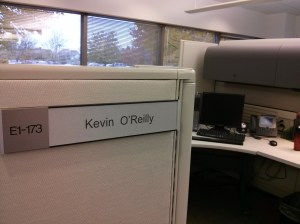
Here is my new cubicle …

2013-11-04 10.00.29 … at the College of American Pathologists, where I started a position Monday as senior editor for a monthly magazine the college publishes, CAP TODAY. The publication focuses principally on clinical issues in pathology, laboratory medicine and laboratory management. So, I have a lot to learn. The job is out in the suburb of Northfield, so I had to buy a car to make the daily commute. It’s interesting work so far and, hey, free coffee! I will, as I’ve done with all my previous jobs, post links to my articles. Given the audience at which the publication is aimed, however, these stories may be less accessible to the general reader than most of my previous work.