Diagnostic errors: Why they happen

My lede:

Within five years, Susan Sheridan’s family was devastated by two diagnostic errors. The first came in 1995, when her newborn son Cal’s early development of jaundice — a red flag for the potential of the severe neurological disorder kernicterus — fell through the gaps in the system despite repeated attempts to alert physicians and other health professionals. As a result of delayed treatment, Cal developed cerebral palsy and has dealt with several other neurological problems.

Then in 1999, Sheridan’s husband, Pat, was told that the mass discovered in his cervical spine was benign. Six months after an apparently successful surgery to remove the mass, Pat again required surgical intervention. This time, physicians said the fist-size tumor was malignant.

But when Sheridan checked her husband’s medical chart, she was shocked to discover a pathologist’s report issued 21 days after the first surgery. The report said that first mass was malignant.

“My knees buckled,” said Sheridan, co-founder and president of Consumers Advancing Patient Safety, a Chicago-based patient advocacy organization. “It was unbelievable to me that a second significant gap in the health care system had tragically impacted my family. It was a double whammy, and it made me realize how very, very fragile our health care system is.”

The pathologist’s report apparently never made it to the neurosurgeon caring for Pat, who died after three agonizing years with spinal cancer and many more surgeries.

Diagnoses that are delayed, wrong or missed entirely result in 40,000 to 80,000 U.S. hospital deaths annually, according to research estimates. About 5% of autopsies find clinically significant conditions that were missed and, if treated, could have resulted in the patient surviving the hospital stay. Meanwhile, about 40% of medical liability lawsuits involve diagnostic errors. Nearly one in three reported adverse events involve diagnostic errors, and more than 10% of these mistakes result in death.

For the Sheridan family, two kinds of diagnostic errors resulted in calamity. In Cal’s case, a series of cognitive errors — not realizing that early-onset jaundice could be a sign of something much worse — was to blame. And a system error — failing to properly communicate a critical test result — was at fault in Pat’s case.

Experts say these two kinds of mistakes often conspire to make diagnostic errors a daunting patient-safety challenge. Fledgling efforts are under way to understand how these errors, which strike at the heart of the physician’s craft, happen and to find ways to prevent them.

Read the whole shebang.
Long shifts, nights on call take toll on surgeons

My lede:

The more hours surgeons work each week, the more depressed and burned out they are, according to newly published survey data.

Surgeons working 80 hours or more a week had the most problems. Nearly 40% reported being depressed, and more than 10% said they made a major medical error in the last three months, said the study, published in the November Journal of the American College of Surgeons. Nearly two-thirds of the surgeons who worked 80 hours a week said they had conflicts between work and personal obligations in the last three weeks.

Read the whole shebang.

The serf of some media

Well, after my recent TV appearance, it is only natural to follow up by broadening my media reach to include the world of books.

A January 2009 feature article I wrote for American Medical News, “Redefining death: A new ethical dilemma,” is included in a new textbook issued by Greenhaven Press. The book, “Bioethics in Mary Shelley’s Frankenstein,” is part of the publisher’s “Social Issues in Literature” series aimed at high-school students and is meant to be a companion for when they read the novel.

The book is broken into three sections — one with background about Shelley, the second featuring commentaries on bioethical issues in the novel, and the third highlighting “contemporary perspectives on bioethics.” That third section is where my story on transplant physicians pushing the boundaries of what constitutes death comes in. Greenhaven sent me a complimentary copy of the book, and perhaps this will push me to actually read the Shelley classic.

The important thing to note is that my prose may now potentially help educate America’s youth — a frightening prospect, indeed. This is almost as scary as when one of my articles — about a poll on physicians’ views of doctor-assisted suicide — was cited by a Montana judge in her opinion (page 22) granting terminally ill patients in that state the constitutional right to physician-aided death. Alarmingly, my sphere of influence is growing ever wider.

The surrogate decision-makers’ dilemma

My lede:

Choosing treatments for patients who cannot do so for themselves puts surrogate decision-makers in an unenviable position. The situation requires that physicians navigate a careful path in offering recommendations while respecting surrogates’ and patients’ wishes, according to two recent medical journal articles.

“Data have shown that the stress of being a surrogate decision-maker is equivalent to the kind of scores people get on psychological instruments when their house just burned down,” said Daniel P. Sulmasy, MD, PhD, co-author of a Nov. 3 commentary on surrogate decision-making in The Journal of the American Medical Association.

Read the whole shebang.

Drug rep visits rarely result in better prescribing

My lede:

Pharmaceutical promotion through drug rep visits, medical journal advertisements and company-sponsored meetings rarely results in higher-quality prescribing, according to a systematic review published in the October PLoS Medicine.

“The big news here is that many physicians deny that they are influenced by information from pharmaceutical companies, and yet we found many studies where there was an association between promotion and the physician’s prescribing,” said Dr. Geoffrey Spurling, senior lecturer at the University of Queensland School of Medicine in Brisbane, Australia. “Physicians need to realize that they are not invulnerable to persuasion techniques.”

Read the whole shebang.

New recognition for first black U.S. doctor with medical degree

My lede:

The New York City burial site of the nation’s first black medical degree-holder received a new headstone — one provided by his white descendants in a recent public ceremony.

Dr. James McCune Smith received his medical degree at the University of Glasgow in Scotland in 1837, forced to go overseas for his education due to U.S. colleges’ racist admissions policies. Historians say the training provided at European medical schools at that time was, ironically, superior to that offered in the U.S.

Read the whole shebang.

Wrong-patient, wrong-site procedures persist despite safety protocol

My lede:

Performing surgery on the wrong body part — or, worse yet, the wrong patient — is the kind of mistake physicians agree should never happen.

A series of reports from hospitals documenting how these devastating errors slip through the cracks prompted the Joint Commission in 2004 to mandate a three-step protocol. It required physicians and other health professionals to perform a pre-procedure verification process, mark the correct site for the procedure and conduct a “timeout” discussion as a final check before the procedure begins.

Yet new evidence shows the commission’s “universal protocol” has not stopped wrong procedures.

In fact, the number of wrong-patient and wrong-site procedure reports rose, according to a study of more than 27,370 adverse events self-reported by Colorado physicians and published in the October Archives of Surgery. The study found that 132 wrong-patient and wrong-site procedures were voluntarily reported to the Colorado Physician Insurance Co. from 2002 to 2008, with peak annual numbers of reports for both categories occurring after the commission’s protocol was required.

Read the whole shebang.

Preventive measures shown to cut hospital C. diff rates

My lede:

Implementing a comprehensive set of infection control measures can cut the incidence of Clostridium difficile significantly, according to a study presented at the American College of Gastroenterology’s annual meeting.

Integris Baptist Medical Center in Oklahoma City was able to cut its C. diff rate by 40%, from 11.3 per 10,000 admissions to 6.9, in three months after forming a multidisciplinary “war on C. diff” committee to devise and implement infection prevention measures.

The infection occurs nearly 500,000 times annually in hospitals and nursing homes. The national C. diff rate is 13 per 10,000 admissions, and about 30,000 people die each year of the disease in health care facilities, according to the Centers for Disease Control and Prevention.

Read the whole shebang.

TV talkin’ post

Yours truly on ESPN. Photo by Pam Dolan.

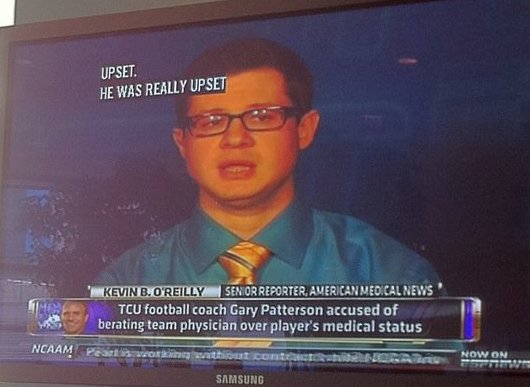
So, my “Put me in, Doc” story blew up last week and by Friday, landed me on ESPN for a brief, live on-camera segment with Bob Ley on “Outside the Lines.”

When Dr. Haraldson told me the story that I used as the lede in my article, I knew it would make a splendid anecdote to illustrate the team physician’s ethical dilemma.

I did not predict, however,  that it would create such a splash in Dallas, Fort Worth and across the college football and sports world. That just shows that my news judgment still has a ways to go.

Here is a rough transcript of my ESPN appearance (scroll down, no video found yet UPDATE: here’s the video), which includes a few of the sweetest words I’ve ever heard uttered: “Now we say hello to Kevin O’Reilly, who reports for American Medical News and first broke this story.”

Opioid safety is focus of $1 million-a-year educational initiative

My lede:

A group that represents patients living with pain has launched an initiative aimed at educating physicians and patients on how to prescribe and use opioids and other pain treatments safely.

The $1 million-a-year project is called Pain Safety & Access for Everyone, or PainSAFE. It comes in response to a striking rise in deaths and overdoses related to opioid abuse and controversy over how the drugs are marketed.

Fatal opioid overdoses tripled to nearly 14,000 deaths from 1999 to 2006, according to Centers for Disease Control and Prevention data reported in September 2009. In June, the CDC estimated that 305,885 emergency department visits in 2008 were related to opioids, more than double the 2004 estimate of 144,644.

Read the whole shebang.