I found my pen

At least for now. This one can seemingly do everything. It’s the Cross Tech 3+.

Simply twist the barrel to switch from black ink, to red ink, to mechanical pencil. Blue ink also is available.
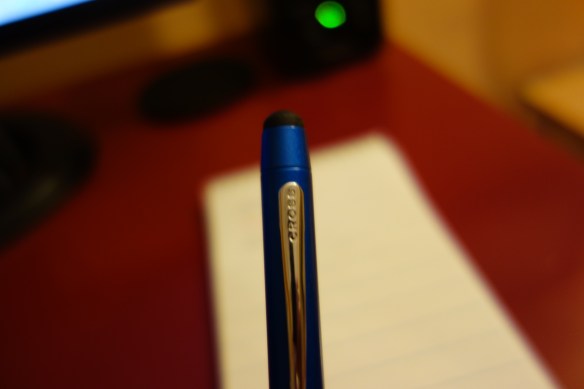
And there’s the plus part, which is that the bottom end includes a nib that smoothly glides across the touch screen on any smartphone or tablet computer.

Which can be unscrewed to reveal an eraser for when the pencil is used. Of course!


Update: Another thing this pen can do, apparently, is become useless fairly quickly. The coating on the stylus nub that made it glide smoothly across the screen started peeling off within a week or two of use. Soon enough, the nub started getting stuck when dragging across my phone’s screen, making it difficult to use. In addition, I had trouble getting the mechanical pencil to remain functional. Every other time I tried to use it, normal writing would push the lead back up into the barrel and I’d have to replace it. Alas, the search for my pen continues.

In childhood obesity battle, BMI-tracking by schools is losing policy

As schools around the country wrap up their first month back in session, parents soon may start receiving the first reports on how their children are shaping up — literally.

Public schools in 19 states now track students’ body mass index numbers and report the fat metrics back to parents. There may, indeed, be more schools tracking students’ BMI than there are schools teaching kids the arithmetic needed to do such calculations on their own. To some, this would seem like the prudent step to take given that childhood obesity has nearly tripled since 1990. The Centers for Disease Control and Prevention says about one in five American children is obese, and one in three is overweight or obese.

There are only a couple of problems with this increasingly popular nanny-state tactic: There’s not much evidence that BMI-tracking reduces obesity, and it may harm the very children it’s meant to help.

My latest, for the R Street Institute. Read the whole shebang.

Health care reads for Sept. 16, 2013

In Sunday’s Chicago Tribune, Peter Frost reports that Illinois is way behind other states in getting the word out about buying insurance under the Affordable Care Act:

At the Minnesota State Fair last month, state employees handed out thousands of paperboard fans bearing pictures of Paul Bunyan and Babe the Blue Ox to promote Minnesota’s health insurance marketplace.

Over Connecticut beaches this summer, airplanes flew banners emblazoned with “Get Covered!” as teams below distributed free sunscreen packets as part of the state’s campaign to get more of its residents insured under the Affordable Care Act.

In Colorado, Oregon and a handful of other states, radio and TV spots have been running for weeks encouraging the uninsured to seek health coverage starting Oct. 1.

In Illinois so far? Mostly silence.

The whole shebang.

And in New York magazine, Jonathan Chait attempts to explain — at length — why Obamacare “continues to drive many Republicans to madness.” He begins:

The Republican party has voted unanimously against establishing the Affordable Care Act in the Senate and then in the House of Representatives, then voted some 40 times to repeal or cripple it; it has mounted a nearly successful campaign to nullify it through the courts and a failed presidential campaign that promised to repeal it; and it has used its control of state governments to block the law’s implementation across vast swaths of the country, at enormous economic cost to those states. Yet somehow, in the wake of all this, the party is consumed with the question Have we done enough to stop Obamacare?

The whole shebang.

American Medical News ceases publication after 55-year run

A dramatic drop in medical-publishing revenues has resulted in the closure of American Medical News, effective with this final edition of the newspaper.

Published for more than five decades, AMNews was hit hard by industrywide trends. The newspaper’s revenue fell by two-thirds during the last decade, said Thomas J. Easley, senior vice president and publisher of periodic publications at the American Medical Association.

“Over a 10-year period of time, we were not able to generate an operating surplus for AMNews,” Easley said. “For some of those years, we were closer to break-even, and in others, we were further away. The last three years saw us get further and further from reaching break-even.”

My very last article in American Medical News. Read the whole shebang.