TV talkin’ post

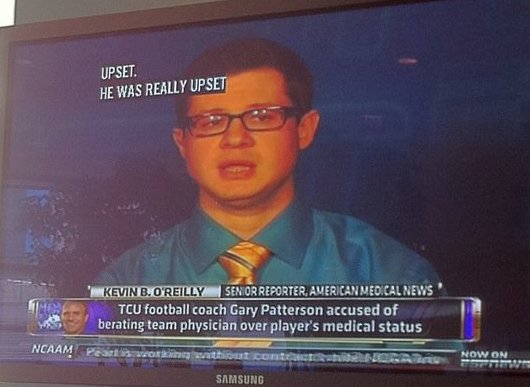
Yours truly on ESPN. Photo by Pam Dolan.

So, my “Put me in, Doc” story blew up last week and by Friday, landed me on ESPN for a brief, live on-camera segment with Bob Ley on “Outside the Lines.”

When Dr. Haraldson told me the story that I used as the lede in my article, I knew it would make a splendid anecdote to illustrate the team physician’s ethical dilemma.

I did not predict, however,  that it would create such a splash in Dallas, Fort Worth and across the college football and sports world. That just shows that my news judgment still has a ways to go.

Here is a rough transcript of my ESPN appearance (scroll down, no video found yet UPDATE: here’s the video), which includes a few of the sweetest words I’ve ever heard uttered: “Now we say hello to Kevin O’Reilly, who reports for American Medical News and first broke this story.”

Opioid safety is focus of $1 million-a-year educational initiative

My lede:

A group that represents patients living with pain has launched an initiative aimed at educating physicians and patients on how to prescribe and use opioids and other pain treatments safely.

The $1 million-a-year project is called Pain Safety & Access for Everyone, or PainSAFE. It comes in response to a striking rise in deaths and overdoses related to opioid abuse and controversy over how the drugs are marketed.

Fatal opioid overdoses tripled to nearly 14,000 deaths from 1999 to 2006, according to Centers for Disease Control and Prevention data reported in September 2009. In June, the CDC estimated that 305,885 emergency department visits in 2008 were related to opioids, more than double the 2004 estimate of 144,644.

Read the whole shebang.

Nobel Prize reflects IVF’s acceptance as medical procedure

My lede:

Four decades ago, a majority of Americans told pollsters that the idea of creating a baby in a test tube went “against God’s will.” In early October, the Nobel Prize in Physiology or Medicine was awarded to one of the men who helped make in vitro fertilization a reality.

Physicians specializing in fertility medicine said the prize — awarded to 85-year-old British biologist Robert G. Edwards — was long overdue and reflects how far the field has come. IVF initially sparked suspicion and condemnation from religious authorities, scientists, medical ethicists and the public.

In the 32 years since, more than 4 million children worldwide have been born with the help of IVF. Doctors have seen the attitudes shift in their patients, who in decades past felt stigmatized when seeking out IVF but today often regard the technique as a first option when natural methods fail.

Read the whole shebang.

Posting emergency wait times: Good marketing or good medicine?

My lede:

Every three minutes, Scottsdale Healthcare in Arizona tells patients how long they can expect to wait to see a doctor or other health professional at one of its four emergency departments. The times are automatically posted on electronic billboard ads and the hospital system’s website.

Posting ED wait times on billboards, websites, Twitter accounts and mobile apps may seem like a way to better serve patients. Yet it could backfire, some physicians say.

Hospital systems from Oregon to Arizona to Virginia see it as an opportunity to boost revenue and smooth patient demand over the course of the day and week, as well as among different EDs they operate. The argument is also made that greater transparency about wait times could encourage hospital administrators to devote more resources to reducing patient boarding and diversion.

But the growing trend could lead to misuse. Patients could self-triage in a dangerous way. There could be inappropriate use of the emergency department. There also might be a misplaced emphasis on door-to-doctor times versus more meaningful measures, such as how long it takes for an ED patient to be admitted or discharged once their care is completed.

Read the whole shebang.

Doctors use Formula One pit crews as safety model

My lede:

First it was aviation, then the Toyota assembly line. Now physicians are looking to auto-racing pit crews for ways to improve health care quality and patient safety.

Hospitals in at least a dozen countries, including the U.S., are learning how to translate the split-second timing and near-perfect synchronization of Formula One pit crews to the high-risk handoffs of patients from surgery to recovery and intensive care. The racing crews can refuel a car and change all four tires in seven seconds, and no F1 driver has died at the wheel in a Grand Prix race since 1994.

The key lessons physicians, nurses and other health professionals can get from these well-honed teams is how to use briefings and checklists to prevent errors, apply technology to transfer key information and learn afterward by mining data, according to a recent study published in the British medical journal Quality and Safety in Health Care. The findings were based on structured interviews with the technical managers of nine F1 racing teams.

Read the whole shebang.